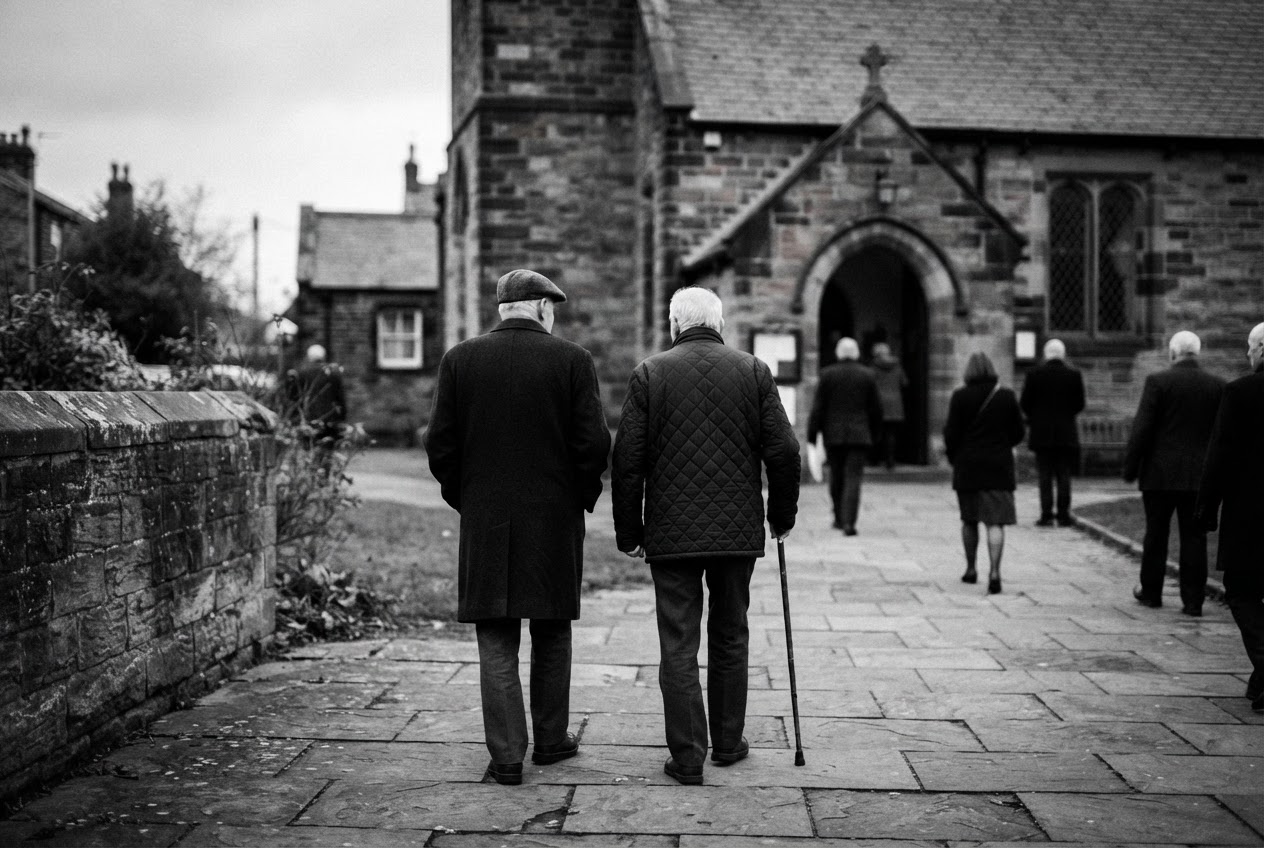
Local man admits he had no evangelisation strategy and was unaware he was participating in missionary discipleship.
NORTH EAST ENGLAND — A lifelong Catholic has expressed surprise at being credited with a successful act of evangelisation after inviting his neighbour to Sunday Mass without first developing a missionary strategy or attending any formal training.
Michael, 69, a retired joiner, has attended Mass at the same parish for most of his life. He became concerned about his neighbour, David, following the death of David's wife earlier this year.
"He seemed a bit lost," Michael explained. "I was going to Mass anyway, so I asked if he fancied coming along."
David accepted.
The two men attended the 9.30am Mass before stopping for coffee on the way home.
Michael subsequently repeated the invitation the following Sunday.
"He seemed to enjoy it," he said. "And it gave him something to get up for."
What began as an ordinary act of neighbourliness developed over several months into a growing interest in the Catholic faith.
David began asking questions about the Mass, the saints and why Catholics kneel during certain parts of the service.
Michael answered as best he could.
"When I didn't know something, I asked Father."
He also lent David a Catechism, showed him how to pray the Rosary and introduced him to several parishioners.
At no stage did he consider these activities unusual.
"I thought I was just helping him out."
The situation attracted wider attention when David approached the parish priest to enquire about becoming a Catholic.
The priest welcomed him and began arranging the appropriate preparation for reception into the Church.
Michael was pleased.
"I thought it was lovely. He's a good bloke."
However, news of the conversion has prompted considerable interest amongst those engaged in the development of new approaches to parish mission.
Michael was subsequently invited to describe the methods he had employed to facilitate David's journey of faith.
He appeared uncertain about the question.
"I used to pick him up about quarter past nine."
Asked how he had established a relationship of accompaniment, Michael explained that the two men had known one another for seventeen years.
"He lives next door."
An enquiry about his approach to creating opportunities for authentic encounter produced a similarly straightforward response.
"We went for coffee."
Those studying the case have nevertheless identified several elements of what appears to be a highly effective model of missionary discipleship.
These include personal invitation, relationship-building, practical support, informal catechesis and sustained engagement with parish life.
Michael was surprised by the terminology.
"I just asked him if he wanted to come to church."
Further examination revealed that he had not attended a course in evangelisation, completed a missionary formation programme or developed any measurable objectives.
Nor had he maintained records of David's spiritual progress.
"How would I do that?" he asked.
He confirmed that his only written record of the arrangement was a note on the kitchen calendar reminding him to collect David on Sunday mornings.
When asked whether he had consciously sought to create a welcoming environment, Michael said he had occasionally put the heating on in the car before setting off.
The enquiry also established that Michael had shared elements of Catholic teaching without using any specially prepared resources.
He explained that David had asked him what Catholics believed about the Eucharist.
"So I told him."
Asked whether he had considered presenting the matter in a less explicitly doctrinal manner, Michael appeared puzzled.
"Well, he wanted to know what we believed."
David has since begun attending Mass independently on occasions when Michael is unavailable.
He has also acquired his own Rosary and is understood to have developed a particular devotion to Our Lady.
Michael described these developments as encouraging.
"He seems much happier. And he's made a few friends."
The experience has prompted interest in whether similar outcomes might be achieved elsewhere through a coordinated programme of personal invitation and informal accompaniment.
Michael was asked whether he believed other Catholics could benefit from learning his approach.
"Probably," he replied. "It's not difficult to ask somebody if they want to come along."
He was subsequently invited to deliver a presentation explaining how his experience might inform the future development of parish mission.
The invitation requested a forty-minute talk covering his understanding of relational evangelisation, the principles of accompaniment and the practical application of missionary discipleship.
Michael declined.
He explained that he did not know enough about any of those subjects to speak for forty minutes.
He was then asked whether he could contribute to a shorter session describing what he had actually done.
"I've already told you," he replied. "I asked him to Mass."
David is now preparing to be received into the Catholic Church.
Michael has continued to accompany him to Sunday Mass, although he remains reluctant to describe the arrangement in those terms.
"We go together," he explained.
The parish priest has expressed gratitude for Michael's kindness and for David's growing faith.
Michael said he was simply glad to have been of some help.
He has since received another invitation to speak about his experience of missionary discipleship.
He has declined once more.
David needs a lift to Confession.
The Northern Thurible is an independent Catholic satirical newspaper. The parish, characters, dialogue and incidents described are satirical inventions and do not refer to identifiable individuals or actual parish activities. This article reflects humorously upon the relationship between formal approaches to evangelisation and the ordinary personal witness of practising Catholics.
Leave a Reply