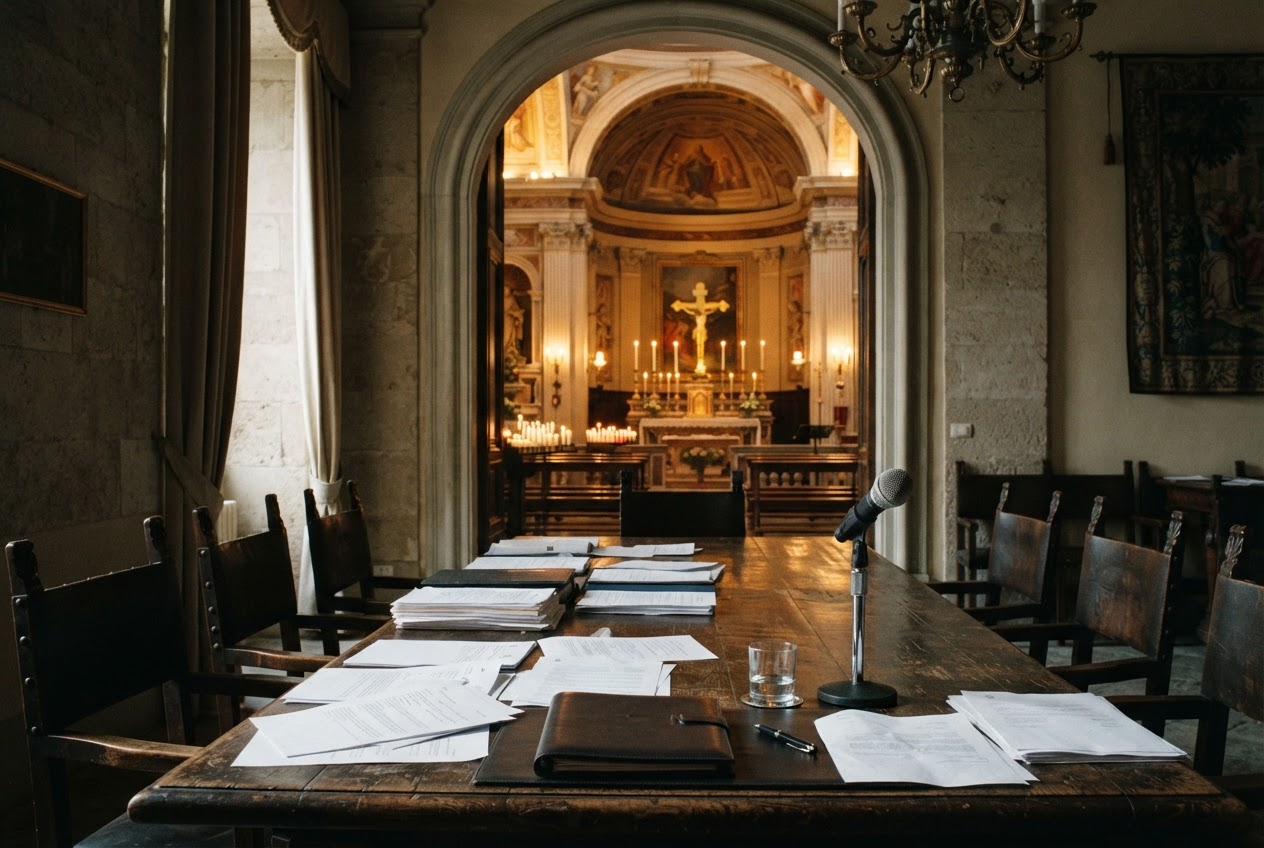
Officials express concern that unstructured contemplation could undermine the Church's commitment to dialogue, participation and measurable engagement.
ROME — An appeal for silence during prayer has prompted an emergency discussion among ecclesiastical communications consultants concerned that too much quiet could undermine their commitment to participation.
The appeal encouraged Catholics to find moments of stillness in which to hear God's voice.
The consultants nevertheless warned that silent prayer presents a number of challenges for the modern Church.
Alessandro, Chairman of the Association for Inclusive Communication and Participatory Listening, described the Pope's remarks as theologically interesting but operationally difficult.
“Naturally, we support the Holy Father's desire for prayer,” he explained. “However, the suggestion that people should remain silent creates some obvious difficulties around engagement.”
According to Alessandro, the principal concern is that traditional contemplative prayer does not provide sufficient opportunities for participants to share their experiences.
“If somebody enters a church, kneels before the Blessed Sacrament and remains silent for half an hour, how are we supposed to know what they thought of it?”
The association has consequently proposed introducing a short feedback questionnaire following periods of Eucharistic Adoration.
Participants will be invited to assess their experience against six key pastoral indicators, including inclusivity, accessibility, emotional resonance and opportunities for personal sharing.
“We cannot simply assume that somebody has encountered God because they have spent thirty minutes praying,” Alessandro explained. “There must be evidence of meaningful engagement.”
The proposal has received support from several consultants who believe that unstructured prayer could inadvertently reinforce traditional hierarchical understandings of Catholic worship.
One adviser expressed concern that the idea of listening to God might establish an imbalance between the divine and human participants.
“We've spent years explaining that the Church must listen to everybody,” she said. “It would be unfortunate if we now gave the impression that God's contribution was somehow more important than anyone else's.”
A draft communications paper has therefore recommended replacing the expression listening to God with participating in a mutually enriching spiritual conversation.
The document also advises against the use of the word obedience, which consultants fear could discourage independent discernment.
“Nobody is suggesting that God should be excluded from the conversation,” Alessandro clarified. “We're simply asking that He refrain from dominating it.”
Particular concern has been expressed about the growing popularity of traditional forms of Catholic devotion amongst younger worshippers.
Consultants have received reports of young people attending Latin Masses, praying the Rosary, making regular Confessions and spending extended periods before the Blessed Sacrament without being invited to contribute to a discussion group.
“This is obviously troubling,” Alessandro explained. “These young people are increasingly engaged with Catholicism, but they're doing it without engaging with any of our engagement initiatives.”
A preliminary assessment has identified Eucharistic Adoration as especially problematic because participants generally face the same direction, rarely introduce themselves and appear to regard the Blessed Sacrament as the principal focus of the gathering.
“From a communications perspective, it's an absolute disaster,” Alessandro said. “There's no welcome activity, no facilitated conversation and no opportunity for participants to express what the Eucharist means to them.”
The review has recommended that future periods of Adoration include an introductory icebreaker, two opportunities for small-group discussion and a closing reflection on how participants might translate their experience into measurable community outcomes.
One consultant suggested that Benediction might be retained as an optional element, provided that sufficient time remained for feedback.
The proposal has encountered resistance from a number of Catholics who maintain that the purpose of Eucharistic Adoration is to worship Jesus Christ rather than to discuss the experience of worshipping Jesus Christ.
Alessandro described this distinction as unnecessarily rigid.
“We must move beyond the old idea that worship is something directed towards God. Worship should be a journey of mutual discovery in which everyone feels equally involved.”
When asked whether the Blessed Sacrament might remain at the centre of the proceedings, Alessandro confirmed that the matter would require further discernment.
“We certainly wouldn't wish to exclude Christ,” he said. “But neither should we construct our entire pastoral model around a single presence.”
The communications department is also reviewing the traditional practice of praying the Rosary, which some consultants believe places an excessive emphasis upon repetition.
“There are fifty Hail Marys in five decades,” Alessandro observed. “Yet not one opportunity for participants to explain how the experience made them feel.”
An experimental alternative is being considered under the provisional title The Participatory Rosary: Fifty Opportunities to Share.
Under the proposals, each decade would conclude with a facilitated discussion, while participants would be encouraged to develop their own personal understanding of the mysteries without feeling constrained by inherited formulations.
A further difficulty has arisen over the practice of kneeling.
Although consultants acknowledge its historical significance, they have expressed concern that kneeling might suggest a relationship of submission rather than equality.
“We have worked extremely hard to build a Church in which everybody has a voice,” Alessandro explained. “It seems a little contradictory to encourage people to get down on their knees.”
The review therefore recommends that kneeling remain optional, with standing, sitting and suitably facilitated movement recognised as equally valid expressions of personal engagement.
A traditionalist priest, consulted during the preparation of the report, reportedly suggested that silence, kneeling and adoration were all ordinary expressions of the Catholic faith.
He further observed that the Church had practised them for nearly two thousand years.
Alessandro acknowledged the historical argument but questioned its relevance.
“We cannot allow the fact that Catholics have done something for two thousand years to become a reason for continuing to do it.”
The priest then suggested that the faithful might occasionally benefit from simply entering a church, kneeling before the tabernacle and speaking privately to Our Lord.
The room fell silent.
After several uncomfortable moments, Alessandro asked whether anybody had been appointed to facilitate the silence.
The department has now commissioned a comprehensive review entitled Beyond Silence: Towards a More Inclusive and Participatory Experience of Not Speaking.
Its recommendations will be submitted for consultation following an initial listening exercise with those who feel their voices have been marginalised by contemplative prayer.
Meanwhile, the Pope's original encouragement to cultivate silence remains unchanged.
Alessandro reassured journalists that the association was fully committed to implementing the Holy Father's wishes.
“We believe silence has an important place in the contemporary Church,” he concluded.
“But we must ensure that nobody is left without an opportunity to speak.”
The Northern Thurible is an independent Catholic satirical newspaper. The communications advisers, their purported organisation, dialogue and proceedings are satirical inventions and do not represent statements or decisions of the Holy See.
Leave a Reply