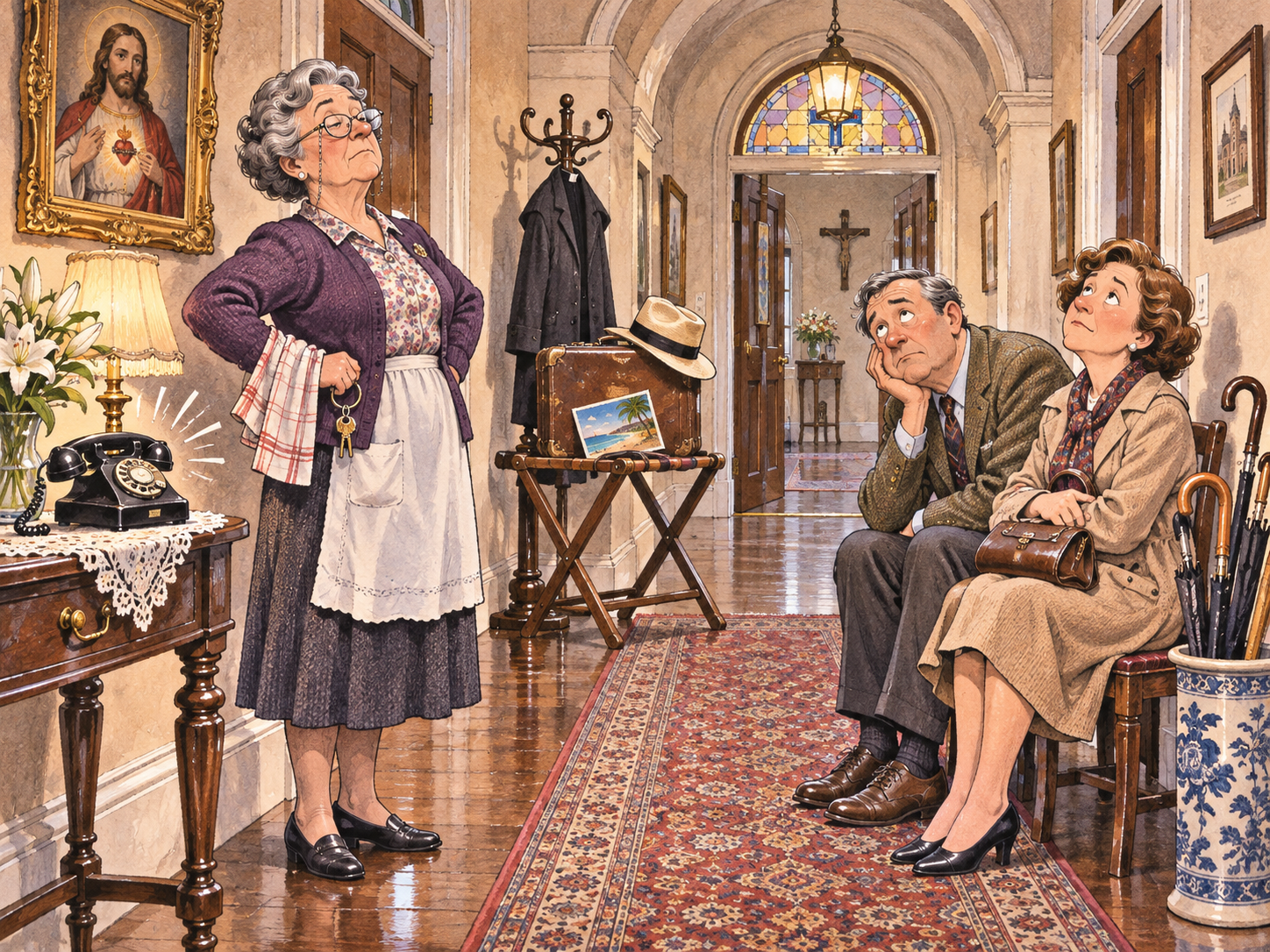
Church authorities urged to investigate loss of formidable women who once protected clergy from their own parishioners.
The Catholic Church has been urged to investigate a possible connection between declining priestly vocations and the disappearance of the traditional presbytery housekeeper.
For generations, these formidable women ensured that priests were fed, clothed and, above all, inaccessible.
A parishioner wishing to speak to Father would first have to convince the housekeeper that the matter was sufficiently important to warrant disturbing him.
“Father's busy,” was generally considered a complete answer.
Those foolish enough to ask when he might be available were informed that she didn't know, although she invariably did.
Her authority was absolute. Even the bishop was expected to telephone ahead, preferably before deciding to visit.
Unlike modern parish administrators, she required no job description, annual appraisal or formal delegation of authority. Her powers derived from an ancient and entirely undocumented source, believed by some canon lawyers to predate the Council of Trent.
She also possessed an extraordinary gift for discernment, being able to determine whether a parishioner's problem was genuinely urgent before allowing them to explain what it was.
One celebrated housekeeper was confronted by a couple who insisted upon seeing the parish priest.
Despite being informed that Father was unavailable, they refused to leave.
Eventually, she invited them to sit in the hallway.
After waiting for some considerable time, the couple asked how much longer he would be.
“Oh, quite a while,” she replied. “He's away on holiday until next week.”
The couple left.
The housekeeper resumed her duties.
Another senior priest recalled that his housekeeper once refused to admit the Vicar General because she had just polished the hallway.
The Vicar General apologised.
Her responsibilities extended well beyond managing visitors. She knew which parishioners were talking to one another, which ones were no longer talking to one another, and precisely which ones Father ought not to be talking to under any circumstances.
She could detect an approaching parish committee member through a closed curtain.
A visiting priest who declined a second helping at lunch would not be invited again.
Researchers now fear that the disappearance of these women has left priests dangerously exposed to telephone calls, parish council meetings and people wishing to discuss the hymn selection.
The Church has produced countless documents on the crisis in priestly vocations, but none has considered the consequences of losing the only woman who could tell a bishop to come back after lunch.
Some have proposed restoring the position, although canon lawyers have been unable to find any provision for it in the Code of Canon Law.
One of the few remaining presbytery housekeepers was asked whether this presented a difficulty.
“Never has,” she replied.
“Now, Father's having his dinner.”
She put the telephone down.
The Northern Thurible is an independent publication of Catholic satire and commentary. While our articles may be inspired by real events, they use humour, exaggeration and fictional elements to explore ecclesiastical life. Any fictional dialogue, conduct or motives should not be understood as factual allegations about identifiable individuals or institutions.
Leave a Reply