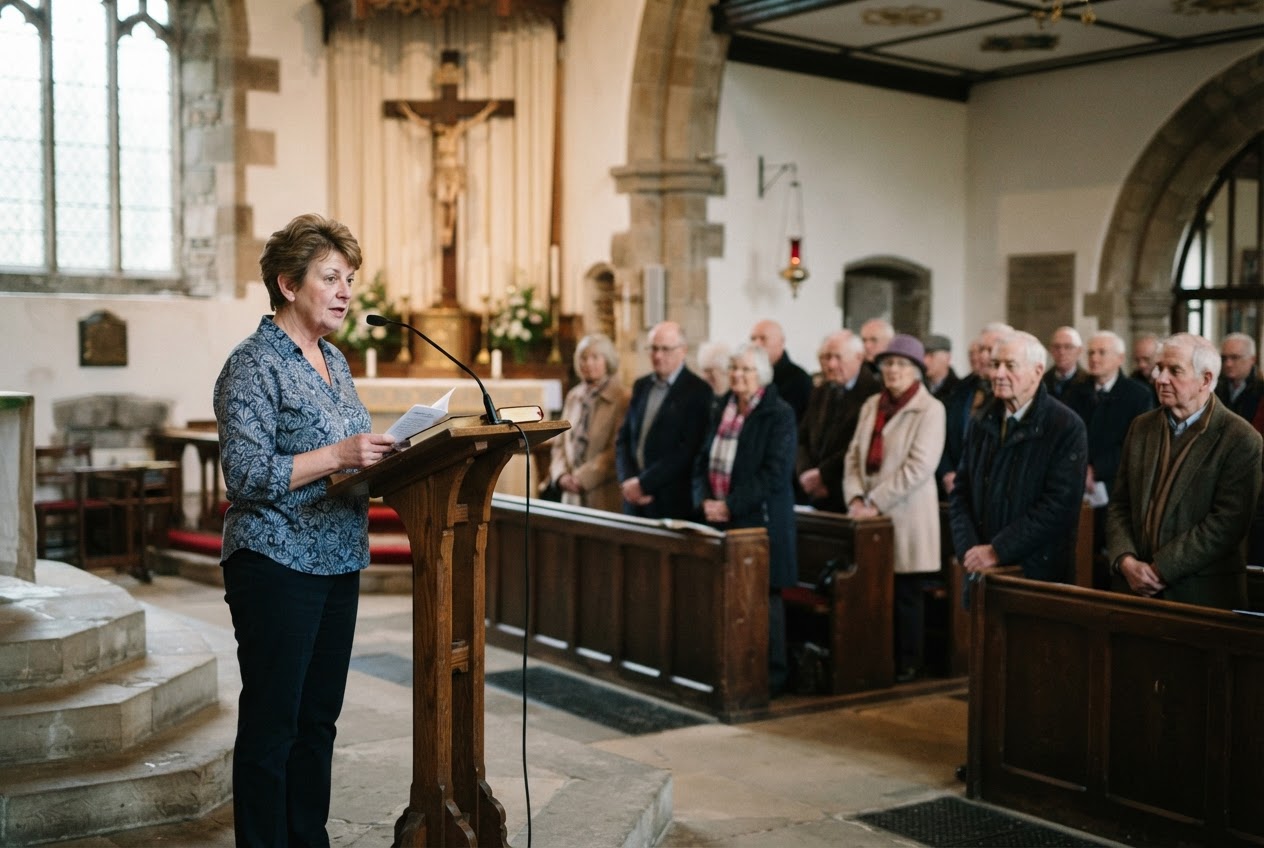
Reader's announcement welcomed by congregation previously thought capable of recognising the Alleluia without assistance.
GATESHEAD — A Catholic parish in Gateshead has introduced additional verbal instructions during Sunday Mass following concerns that members of the congregation may no longer remember when to stand, sit or kneel.
The initiative follows a routine Sunday celebration during which the reader, having completed the second reading, informed worshippers that they should now stand to greet the Gospel.
The announcement was delivered immediately before the Alleluia, which parishioners had previously understood to be a reasonably reliable indication that the Gospel was approaching.
Margaret, 74, who has attended Mass every Sunday since 1958, welcomed the clarification.
“I was completely lost,” she explained. “After sixty-eight years, I had absolutely no idea what was coming next.”
She confirmed that she had been preparing to remain seated throughout the Gospel, despite having stood for it on approximately 3,500 previous occasions.
“Thank goodness somebody told us. I might have made a complete fool of myself.”
The new arrangements form part of a wider initiative to ensure that parishioners receive adequate notice of developments during Mass before they occur.
Eileen, the parish's Coordinator for Liturgical Participation and Congregational Movement, explained that it was no longer considered sufficient to assume that regular Mass-goers understood the order of proceedings.
“We cannot simply expect people to know what to do,” she said. “Some of them have only been Catholics for seventy or eighty years.”
She defended the reader's announcement, explaining that communication was central to the parish's commitment to active participation.
“Traditionally, the congregation would stand when the Alleluia began. But that rather depends upon people recognising the Alleluia.”
Eileen acknowledged that the word had been sung in Catholic churches for many centuries, although she warned that its pronunciation remained a matter of considerable uncertainty.
“We have one lady who has attended Mass here for forty-three years and still manages to insert an additional L between the U and the I,” she explained.
“She sings Allelullia with such confidence that several newer parishioners have started copying her.”
The parish briefly considered issuing guidance on the correct pronunciation but concluded that correcting somebody who had been singing it incorrectly since 1983 would be pastorally insensitive.
Instead, the music group has agreed to introduce a short pause before the final syllable, allowing the congregation to accommodate whichever version is being attempted.
“We have to be very careful,” Eileen explained. “People become attached to these things. We don't want to undermine anyone's confidence in their own pronunciation.”
Asked why the congregation needed reminding to stand but could not be reminded how to sing Alleluia, Eileen described the comparison as unhelpful.
“Standing is a matter of liturgical order. Pronunciation is a matter of personal expression.”
Under the revised arrangements, readers will now be encouraged to provide a short explanation before each significant liturgical movement.
Proposed announcements include “We shall now sit down to listen to the readings”, “Please remain seated while the priest gives his homily” and “The collection will shortly begin; this is the part where money is required.”
A further announcement is being considered before Holy Communion to remind communicants that they should approach the altar rather than remain indefinitely in their pews.
One parishioner questioned whether the established words, music and actions of the Mass might already provide sufficient guidance.
Eileen rejected the suggestion as excessively dependent upon tradition.
“We have to remember that not everyone is familiar with the liturgy.”
Asked whether the parish was experiencing a significant influx of new Catholics, she confirmed that attendance had remained almost entirely unchanged for the past fifteen years.
“Which makes it all the more important that we keep reminding them.”
The parish priest has reportedly expressed mild concern that the additional commentary could interrupt the natural flow of the celebration.
He was reassured that the announcements would be kept to an absolute minimum.
The latest draft contains seventeen.
There has also been discussion about whether parishioners should be reminded to make the Sign of the Cross at the beginning of Mass.
One committee member suggested that a verbal instruction might be unnecessary, given that the priest already says, “In the name of the Father, and of the Son, and of the Holy Spirit.”
Eileen disagreed.
“That is precisely the sort of assumption we are trying to move away from. Just because the priest says something doesn't necessarily mean the congregation knows what to do.”
The committee has consequently proposed a brief explanatory announcement immediately before the priest begins speaking.
Meanwhile, a small group of parishioners has continued to stand for the Gospel without waiting for instructions.
Their behaviour is being monitored.
“We don't want people taking matters into their own hands,” Eileen explained.
“Once parishioners start standing up without being told, who knows where it might lead?”
The parish has confirmed that next Sunday's Mass will include a brief announcement explaining that the service is about to begin.
Parishioners are advised to arrive early.
The lady who sings Allelullia has confirmed that she will be attending as usual.
She sees no reason to change anything.
The Northern Thurible is an independent Catholic satirical newspaper. The parish, characters, quotations, liturgical initiatives and incidents described are fictional. This article satirises unnecessary commentary during worship and familiar parish peculiarities; it does not report the conduct of any identifiable parish, reader, musician or member of the clergy.
Leave a Reply