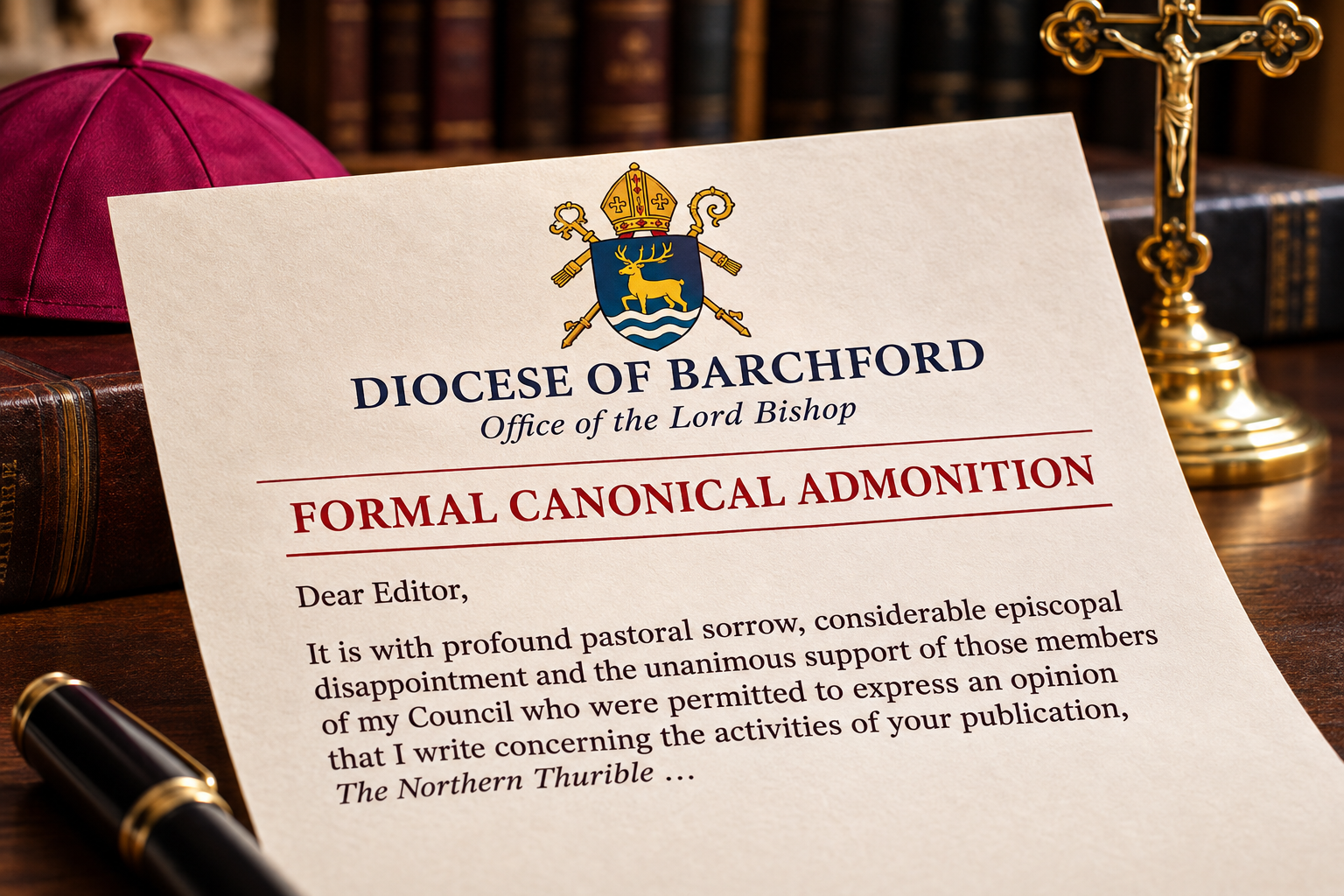
The Bishop of Barchford expresses grave concern over obedience, ecclesiastical discipline and the increasing number of priests laughing at diocesan expense.
DIOCESE OF BARCHFORD
OFFICE OF THE LORD BISHOP
Episcopal Secretariat for Ecclesial Communion, Pastoral Discipline and the Prevention of Unauthorised Opinions
STRICTLY PRIVATE AND CONFIDENTIAL
FORMAL CANONICAL ADMONITION
Dear Editor,
It is with profound pastoral sorrow, considerable episcopal disappointment and the unanimous support of those members of my Council who were permitted to express an opinion that I write concerning the activities of your publication, The Northern Thurible.
I had initially hoped that this unfortunate enterprise might disappear through prayer, pastoral accompaniment or a natural decline in readership.
Regrettably, I am advised that the opposite has occurred.
Of particular concern are reports that several priests have been reading your articles voluntarily, with some apparently laughing aloud.
One parish priest is alleged to have forwarded an article to three colleagues with the words, “This is painfully accurate.”
I have referred the matter to the Vicar for Clergy.
You will appreciate that such behaviour cannot be allowed to develop unchecked.
Having consulted the Diocesan Chancellor, the Episcopal Council and the Working Group for the Discernment of Appropriate Ecclesial Communications, I must now remind you of your obligations under the Code of Canon Law.
I. On Obedience to Sacred Pastors
Canon 212 §1 requires the Christian faithful to show Christian obedience to their sacred pastors in matters concerning the faith and governance of the Church.
Your continued publication of articles questioning diocesan strategies, parish restructuring and the effectiveness of our numerous consultative bodies suggests a troubling misunderstanding of this obligation.
For example, your description of the diocesan pastoral strategy as “an elaborate mechanism for managing decline while celebrating progress” has caused considerable offence.
Our strategy is not concerned with managing decline.
It is concerned with accompanying communities through a carefully discerned process of sustainable numerical reduction.
The distinction is fundamental.
II. On the Right to Express Opinions
I am aware that Canon 212 §3 recognises the right, and at times the duty, of the faithful to make known their views on matters concerning the good of the Church.
Unfortunately, you appear to have read this provision in its entirety.
I must remind you that the exercise of such rights requires due regard for reverence towards one's pastors and the common good.
It was never intended to provide an unrestricted licence for laypeople to notice things.
Indeed, a considerable amount of episcopal time is now being consumed responding to matters which, until recently, the faithful had been perfectly content not to understand.
III. On the Protection of Reputation
Canon 220 protects the good reputation of every person.
Your articles have placed this fundamental right at considerable risk, particularly among members of the diocesan administration.
The Director of Mission and Synodal Development informs me that he can no longer use the phrase “journeying together” in public without encountering suppressed laughter.
The Episcopal Vicar for Pastoral Renewal has similarly expressed distress at being asked whether the latest consultation will take place before or after the decisions have been made.
I understand that the question was asked with a straight face.
This makes the matter considerably worse.
IV. On Incitement Against Ecclesiastical Authority
Your attention is drawn to Canon 1373, which addresses certain forms of public incitement against ecclesiastical authority.
I have asked the Diocesan Chancellor whether your persistent ridicule of episcopal processes might constitute an offence under this provision.
He has advised that satire, criticism and occasional irreverence do not, in themselves, meet the requirements of the canon.
I have instructed him to reconsider.
He has subsequently referred me to Canon 212 §3.
His position as Chancellor is currently under review.
V. On the Common Good of the Church
Canon 223 requires the faithful, in exercising their rights, to take account of the common good of the Church.
I must emphasise that the common good is not advanced by suggesting that our diocesan pastoral consultations are merely elaborate exercises in securing agreement with decisions already taken.
Such suggestions demonstrate a fundamental misunderstanding of synodality.
The purpose of consultation is to ensure that everybody is heard.
It is not necessary that everybody be listened to.
Still less is it necessary that anything should change.
I trust this clarification will prevent further misunderstanding.
VI. On Liturgical Matters
I am particularly disturbed by your treatment of contemporary liturgical practice.
Your references to prayer focus tables, coloured fabric, carefully arranged stones and electronic keyboard accompaniment have caused unnecessary embarrassment to several highly committed members of our Diocesan Liturgy Commission.
These colleagues have devoted many years to ensuring that the liturgy remains accessible, inclusive and sufficiently familiar to anybody who attended a parish renewal weekend in 1978.
Your insinuation that the average diocesan youth liturgy is organised by people approaching retirement is deeply uncharitable.
Several are already retired.
Furthermore, I must remind you that the placement of six pebbles around a candle is not, as you have suggested, a substitute for theological formation.
It is the result of theological formation.
VII. Required Acts of Reparation
In view of the seriousness of these matters, I hereby direct you to undertake the following corrective measures:
- Cease referring to diocesan restructuring as managed decline, and adopt the approved term Mission-Led Pastoral Realignment.
- Refrain from suggesting that diocesan committees exist primarily to establish further committees.
- Recognise that a parish does not cease to be vibrant merely because it has no resident priest, no regular Sunday Mass and insufficient parishioners to form a choir.
- Withdraw all insinuations that the Diocesan Youth Ministry Strategy is principally designed by people who remember the introduction of the New Mass.
- Submit any future references to synodality, accompaniment or pastoral renewal to the Diocesan Communications Office for preliminary discernment.
You are also required to cease suggesting that our diocese has replaced evangelisation with spreadsheets.
The latest Mission Effectiveness Monitoring Framework contains several provisions specifically addressing evangelisation.
These can be found on the fourth tab.
VIII. Final Admonition
I trust you will appreciate the seriousness with which I regard this matter.
Should your activities continue, I may have no alternative but to refer the publication to the Episcopal Commission for Ecclesiastical Communications, following the appropriate consultations and the establishment of a preliminary working group.
I am advised that such proceedings could take between eighteen months and three years.
I would therefore urge you to consider your position without delay.
Finally, I must expressly forbid the publication, reproduction, quotation or satirical interpretation of this correspondence.
Any attempt to make this letter itself the subject of public amusement would constitute a grave breach of the trust which ought to exist between a bishop and his people.
Please be assured that I bear you no personal ill will.
I have, however, asked the Diocesan Communications Office to monitor your website daily.
This is purely pastoral.
I remain,
Yours devotedly in Christ,
✠ The Right Reverend Lord Bishop of Barchford
Successor of the Apostles, Guardian of Ecclesial Communion and Moderator of the Diocesan Committee for the Regulation of Ecclesiastical Humour
Dictated but not read.
Copies: Vicar General; Diocesan Chancellor; Episcopal Vicar for Mission; Director of Communications; Chair of the Synodal Implementation Group; Personal File; Rome (if necessary).
The Northern Thurible is a satirical publication. The fictional Diocese of Barchford, its bishop, correspondence and disciplinary proceedings are entirely fictional. The canonical provisions referenced are genuine, but their interpretation and application in this imagined correspondence are satirical. No real bishop or ecclesiastical authority is alleged to have issued this warning.
Leave a Reply