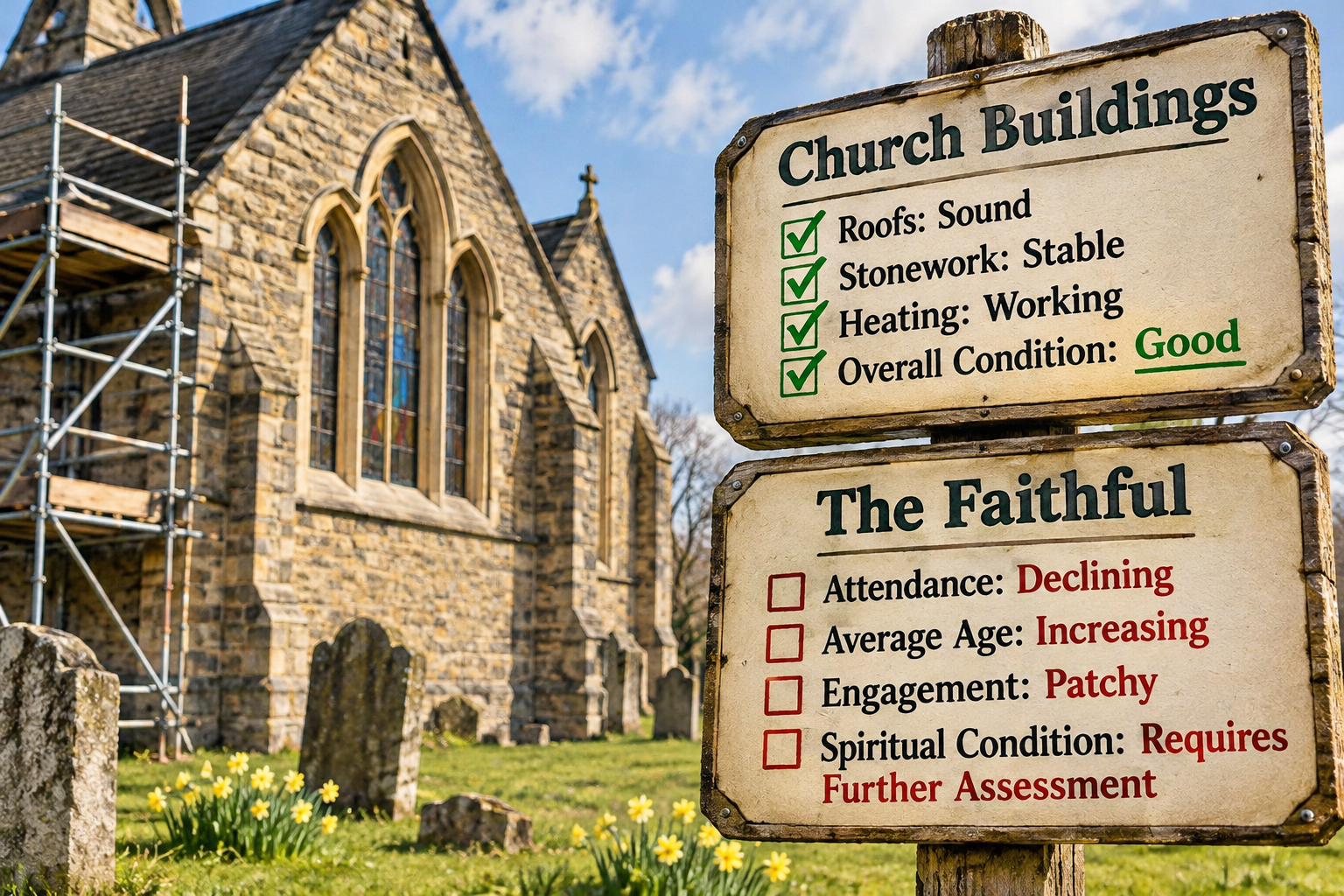
Officials welcome encouraging findings on the condition of the diocesan estate, while acknowledging that the faithful are proving considerably harder to maintain.
A diocesan property review has concluded that the Church's buildings are in considerably better condition than the Church itself, prompting cautious optimism amongst officials responsible for the management of the estate.
The review, commissioned to assess the condition of churches, presbyteries and parish halls, found that while several buildings required urgent attention, the state of the laity presented a rather more complicated problem.
“We are delighted that so many of our buildings remain structurally sound,” explained a diocesan official. “Unfortunately, we cannot say the same for the congregations.”
The report praised the resilience of Victorian stonework, the durability of church roofs and the continued performance of parish heating systems, noting that all three had demonstrated greater signs of vitality than much of the Sunday congregation.
Inspectors reported that several churches remained in excellent condition, despite ageing congregations, declining attendance and a growing proportion of parishioners whose principal religious commitment appeared to involve leaving immediately after Communion.
Particular satisfaction was expressed at the discovery that some churches remained almost entirely undamaged by the faithful.
“From an asset management perspective, this is extremely encouraging,” the official continued. “A congregation of twelve can do remarkably little damage to a building designed for six hundred.”
The report also noted that the average age of parishioners was now approaching that of certain post-war church extensions, although the latter were generally considered to have a longer remaining useful life.
When asked whether the diocese intended to commission a similar assessment of the spiritual condition of the laity, officials expressed concern that the findings might prove difficult to quantify.
“We can inspect a roof, commission a structural survey and establish exactly what needs repairing,” explained one trustee. “But when it comes to the spiritual life of the faithful, there are rather fewer reliable indicators.”
He acknowledged that Mass attendance, vocations, religious practice and knowledge of the faith might offer some guidance, but warned against becoming excessively preoccupied with measurable outcomes.
The review recommended continued investment in preventative maintenance, noting that neglected gutters could eventually threaten the structural integrity of the estate.
Asked whether a similar programme of preventative maintenance might benefit the faith of successive generations, officials confirmed that the matter fell outside the scope of the survey.
One trustee nevertheless expressed concern that the diocese could eventually find itself responsible for an extensive portfolio of beautifully maintained churches containing very few Catholics.
The official was reassured that the buildings would retain considerable historical and architectural significance, even if their original purpose became increasingly difficult to demonstrate.
The review concluded that the diocesan estate remained its most tangible asset, while acknowledging that faith, hope and charity were considerably more difficult to enter on a balance sheet.
A further review has been proposed to establish whether these might qualify as intangible assets under current accounting standards.
The Northern Thurible is an independent Catholic satirical newspaper. This article is entirely fictional and intended for humorous purposes. The property review, findings, officials, trustees, statements and quotations described are invented. They do not refer to an actual diocesan review or represent the views, actions or statements of any real diocese or individual.
Leave a Reply